Supreme Court Strikes Down the IEEPA Tariffs — But Markets May Be Staring at Something Worse
— Douglas
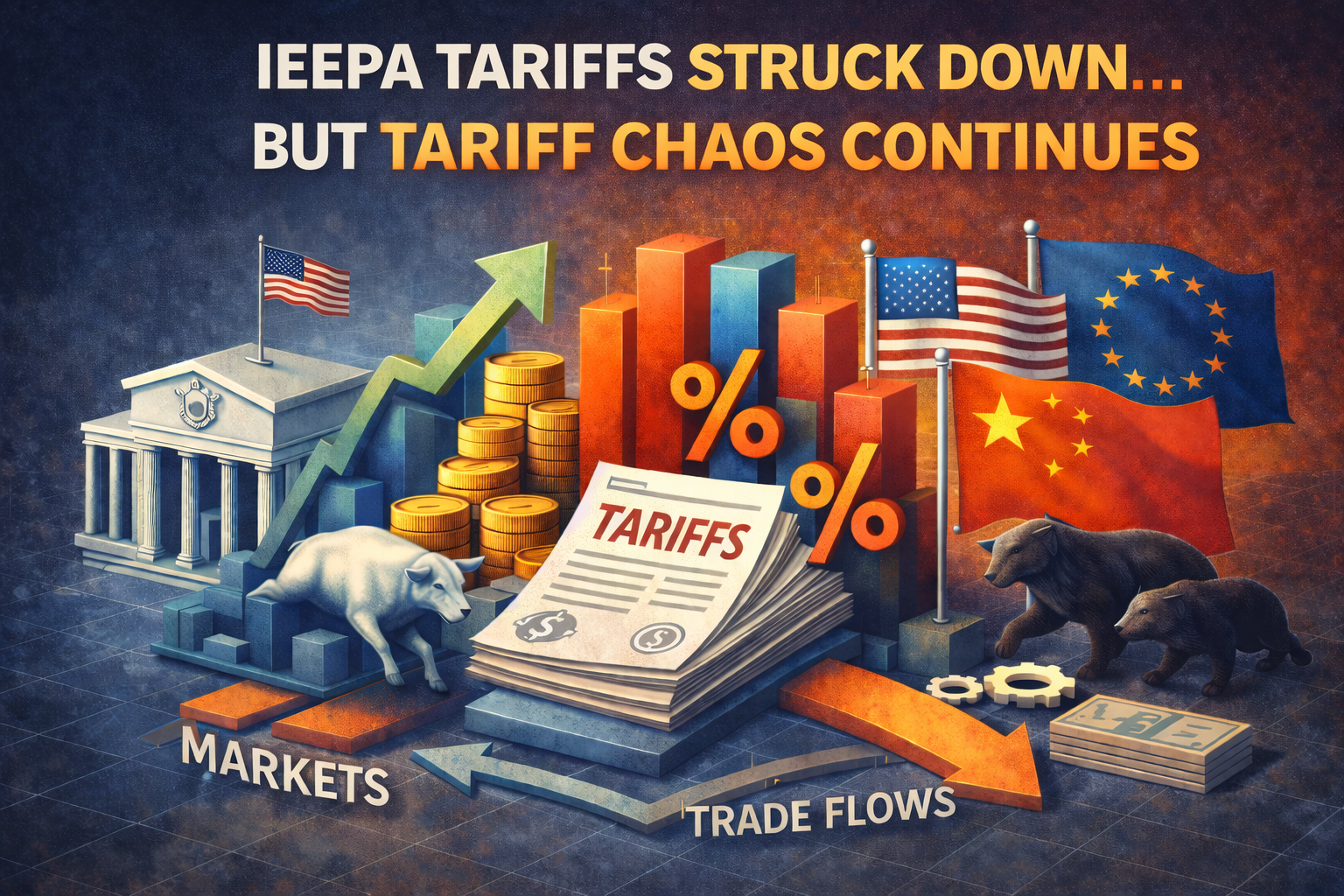
This past Friday, we finally got the macro headline a lot of us have been waiting on: the Supreme Court ruling on the IEEPA tariffs. The decision came down early Friday morning, and the court deemed the IEEPA tariffs illegal—effectively ending the version of the tariff regime that began on “Liberation Day” last year.
If you remember the mood a year ago, we were stepping into a chaotic policy experiment: a massive wave of tariffs, a lot of uncertainty, and a market trying to price the downstream effects in real time. Now, one year later, the original structure of those tariffs has been ruled unlawful.
But here’s the catch:
The end of the EPA tariffs doesn’t necessarily mean the end of tariff-driven damage. In fact, based on what followed, we may be walking into something that’s economically worse than what we just got rid of.
The Market Reaction: Calm… Then Chaos
The immediate market response to the Supreme Court decision was surprisingly muted. Friday’s session was fairly “meh” at first—there was a modest rally into the close, but nothing that screamed regime shift.
Then the follow-on headline hit.
Right near the end of the session—after markets had mostly digested the SCOTUS decision—we got the next move from Trump. And once markets were closed, things got even more uncertain.
The initial announcement: a global 10% tariff.
Then, about an hour later: talk of pushing it up to 15%.
So the real question shifted quickly from:
“Tariffs are illegal—does that remove a headwind?”
to:
“Okay… what replaces them, and is it even worse?”
Monday’s Selloff: Uncertainty Gets Priced as Volatility
Markets don’t like uncertainty, and Trump-driven policy is often uncertainty by definition. The way the market digests uncertainty is predictable:
- uncertainty → volatility
- volatility → lower prices
And that’s exactly what we got today. The S&P 500 sold off aggressively, down roughly 1.5% at the lows at one point.
At this stage, the picture still isn’t perfectly clear—but it’s getting clearer. And what concerns me is that we may end up worse off than where we started, even though the original tariffs have been struck down.
Why Tariffs Matter: First-Order, They’re a Tax
I’ve been consistent on this point and I’ll keep repeating it because it’s the foundation:
Tariffs function like a tax.
Mechanically, they operate in the macro balance sheet exactly like taxes do. The importer pays the tariff domestically, and it shows up on the Daily Treasury Statement right alongside tax receipts on the deposit side.
That means tariffs are:
- revenue for the government sector
- paid by the private sector
- a net transfer of financial resources out of private sector balance sheets
And that’s where the macro problem begins.
The Macro Problem: Wealth Transfer Out of the Private Sector
The private sector needs a steady supply of profits and financial assets to expand, invest, and take risk. When the government removes those financial assets (whether via higher taxes, tariffs, or other mechanisms), the private sector’s ability to leverage up and grow deteriorates.
We’ve seen versions of this dynamic in major stress periods:
- 2000
- 2008
- 2022
When you get sustained drag on private sector balance sheets, that’s when recessions, crises, and bear markets show up.
So yes—tariffs are “trade policy,” but from a macro standpoint they are a headwind to growth because they reduce private sector income and wealth.
“But Won’t Tariffs Spur Domestic Investment?”
This is the standard counterargument: if imports get more expensive, domestic firms invest to produce locally.
But there’s a critical flaw that gets ignored:
Investment doesn’t happen just because something is more expensive to import. It happens when profits justify the investment.
And tariffs—by definition—reduce private sector profits.
So you’re trying to argue that a policy which removes profits will somehow create the profitability needed for the next big wave of investment. That’s internally inconsistent.
If we’re already in the later innings of the business cycle, the hurdle rate matters more than ever. And it’s not just about “AI investment” or speculative capex pockets—broad-based, healthy cycle investment has been relatively lackluster.
At the end of the day, the business cycle runs on one thing:
the next loan has to clear.
The next expansion has to be viable.
The next investment has to pencil.
Policies that impair profitability make that harder.
The New Reality: Section 122 Tariffs Might Offset (or Exceed) What Was Struck Down
Now let’s talk about the new tariff path, because this is where the worry comes in.
As I understand it right now:
- After the ruling, an executive order (dated February 20) introduced 10% global tariffs
- There’s chatter they may be pushed toward 15%
- We don’t yet know about carve-outs
- We don’t know whether this “double dips” on categories where some tariffs may still remain legal
- The current talk is that these Section 122 tariffs may run for 150 days, potentially while the administration looks for other legal pathways under the Trade Act
Here’s the important part: even if the EPA tariffs are voided and refunds occur, the new tariffs could still represent equal or greater wealth extraction from the private sector.
I did some rough back-of-the-envelope math in the video:
- US imports are around $4.3T
- A 10% tariff rate applied broadly implies ~$430B annualized in tariff collection
- Realistically, it won’t apply perfectly across everything—but even on a fraction, it can still be enormous
- You mentioned ~$170B potentially being refunded from the prior year’s collections
The key takeaway:
It’s “really close” whether this results in any less wealth destruction at all— and it could easily be more.
Which means: the market may not be celebrating the end of EPA tariffs because it may be anticipating the next structure being just as damaging—or worse.
What I’m Tracking: Tariff Flows and Fiscal Deceleration
This is where the Applied MMT toolkit comes in, because we track tariff receipts directly and continuously.
On the site, we visualize:
- tariff collections over time (with moving averages to smooth 30-day patterns)
- the “Liberation Day” spike beginning in April
- recurring monthly “tariff grabs” (often clustering mid-month)
- the recent trend of tariffs waning into January as front-running faded and imports slowed
That front-running is important. Early on, imports surged ahead of the tariff implementation (people rushing to get goods in before costs rose). Then, as expected, imports started to slow—which naturally reduced tariff collections.
We were starting to see:
- a dissipation of tariff headwinds
- trade agreements nibbling away at the drag
- potential stabilization in macro flows
And now this new Section 122 path may disrupt that entirely.
The Trump Spending Tracker: A Clear Signal of Flow Deceleration
The other tool I referenced is what I call the Trump Spending Tracker—built originally to compare fiscal behavior early in the administration to the prior year baseline.
What it shows is something I’ve been focused on since late 2025:
a strong deceleration in underlying spending beginning around August into September.
That deceleration lined up with when tariffs became a prominent deposit-side contributor on the Daily Treasury Statement.
And as I’ve said many times:
Markets don’t just price the level of flows.
They price the acceleration and deceleration of flows.
That shifting rate-of-change is what changes expectations for growth and returns—and ultimately how risk assets get discounted.
This is also why I made the case back around late September / early October 2025 that flows were vanishing and markets were likely to take a hit. We haven’t seen a massive crash, but we also can’t pretend the last 4–5 months have been impressive.
We’ve largely churned sideways.
Flows slowed. Markets stalled.
So What Now?
At this point, the only responsible approach is to keep tracking the data in real time.
Over the coming weeks and months, the questions I’m focused on are:
- What does the new tariff regime actually collect in practice?
- Are there carve-outs or exclusions that reduce the headline rate?
- Does Section 122 collect less than the prior EPA regime—or more?
- What’s the net effect on fiscal flow overall?
- Do we see continuing deceleration—or do flows re-accelerate?
My base-case from the transcript is straightforward:
It probably ends up worse.
And if that’s true, it’s not just a “trade story.”
It’s a story about fiscal drag, flow deceleration, and the main driver of asset prices potentially weakening further over the next 3 to 6 months.
My Current Stance: Still Leaning Bearish, Watching for Another Leg Lower
I mentioned in the video that I posted an update over the weekend for pro members. In that update, I made the case that we’re likely close to another leg lower, and I still stand by that assessment.
The market is trying to price a moving target:
- legal rulings
- executive actions
- changing tariff structures
- changing revenue extraction from private sector balance sheets
When uncertainty rises and flows deteriorate, markets typically don’t respond with confidence.
They respond with volatility.
And volatility tends to push prices lower.
So for now: we watch the Daily Treasury Statement, we watch tariff receipts, and we watch the flow trajectory.
Because as always—
follow the flows.
If you want to watch the full video where I walk through the decision, the tariff mechanics, and what I’m monitoring next, you can watch it here: