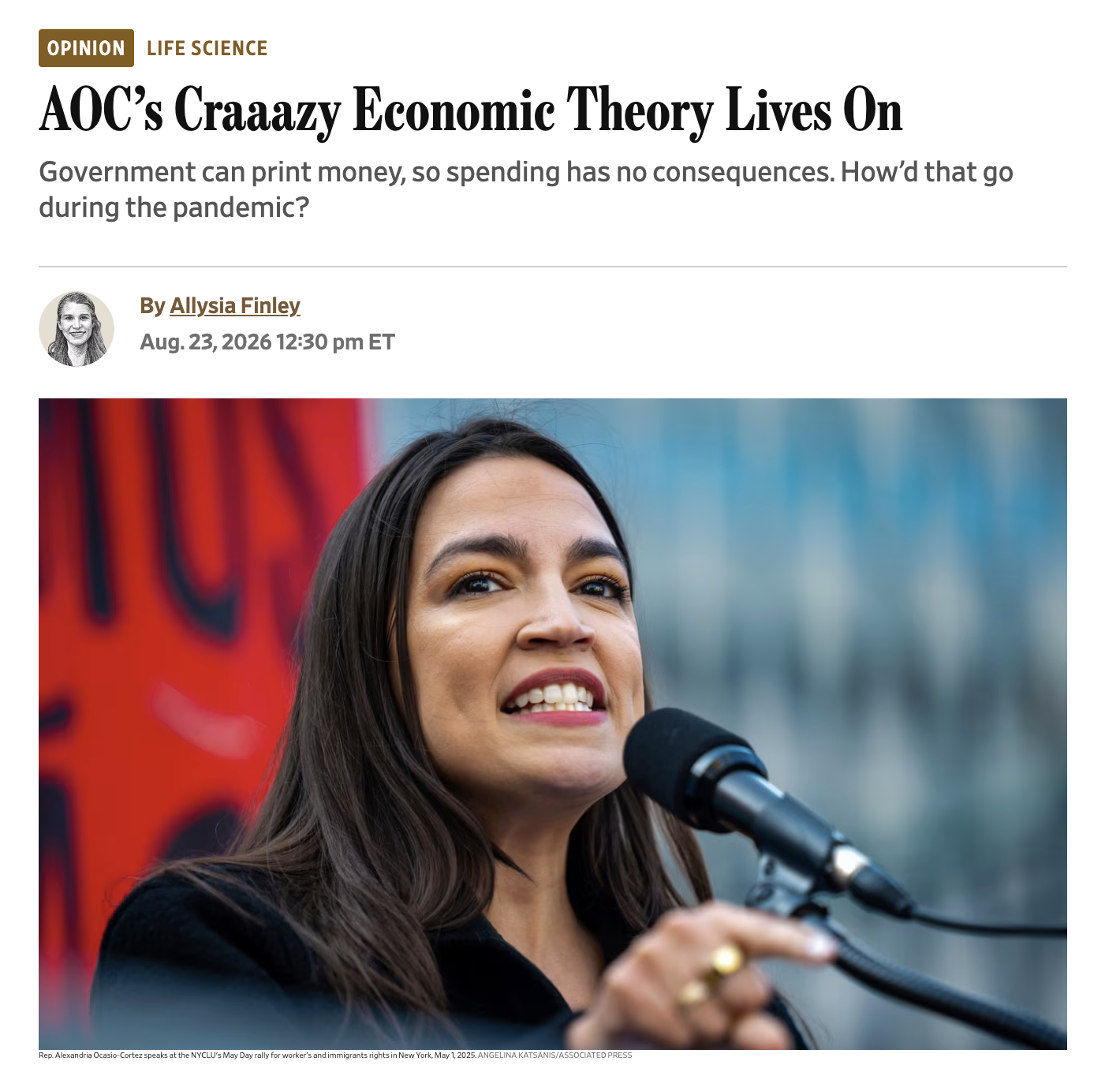
On August 23, 2026, The Wall Street Journal ran an opinion piece written by Allysia Finley titled "AOC's Craaazy Economic Theory Lives On," with the subhead "Government can print money, so spending has no consequences. How’d that go during the pandemic?"
The argument runs like this: "experimenting" with Modern Monetary Theory, pandemic-era government spending was untethered from any funding constraint, the Fed accommodated it with zero rates and Treasury purchases, inflation followed, the national debt is now $40 trillion, and the tax-the-rich remedy offered by the people who championed the spending can't come close to paying for their ambitions.
Setting aside the fact that no MMT-associated economists were officially involved with the Trump or Biden administrations during the pandemic response, let's address Finley's arguments.
The Tax Arithmetic
Finley's numbers: a 5% annual wealth tax on billionaires raises roughly $2.3 trillion over a decade, about one year of fiscal deficits. Confiscating every dollar of US billionaire wealth, around $8.4 trillion, would return gross debt to roughly where it sat in spring 2023. A 70% top marginal rate on income above $10 million raises around $300 billion over ten years, against a Medicare for All estimate of $34 trillion over that same window, under 1% of the bill. CBO's upward revision to Medicare prescription drug costs alone, roughly $700 billion over the next decade, is more than twice what the rate increase collects.
Those figures are correct. However, the fundamental issue is that taxes were never a "funding" mechanism to begin with. A currency issuing government spends by crediting bank accounts. Taxation and spending are operationally independent. Taxes do real work: they create the demand for the currency, they manage inflation, and they redistribute, but "how do we pay for it?" is the wrong first question, and both sides of this debate keep asking it.
The binding constraint is productive capacity: the workers, materials and machines actually available at the prices the government is willing to pay.
What Modern Monetary Theory Actually Claims
This piece is arguing with something other than MMT. It's attacking a straw man of MMT.
Start with the load-bearing premise: that MMT was "tried" during the pandemic. It wasn't. There is no "doing" MMT. MMT simply describes the monetary system as it already functions. What was enacted by the Trump and Biden administrations in response to the COVID pandemic were emergency measures using the tools the federal government had and has always had at its disposal. Congress spent a great deal of money quickly, which governments have done in every war and most crises in the country's history.
Then the subhead: MMT claims that spending has no consequences. In reality, the claim is closer to the reverse. Consequences are virtually the entire subject of MMT. What MMT says is that the binding constraint on a currency issuer is real: workers, materials, capacity, and the inflation that shows up when the government bids for resources that aren't there, rather than financial. A government that issues its own currency cannot run out of its own currency. It can absolutely run out of the things that currency buys, and that is the constraint that matters. This was particularly relevant during the pandemic when global supply chains were crippled.
That MMT claims “deficits don't matter” is a similar straw man argument. What MMT states is that fiscal deficits don't create solvency risk for currency issuers. Their size and composition matter enormously for inflation, for distribution, and for who ends up receiving the income.
The step that really kneecaps Finley's piece is the claim that the government had to “lean on the Fed to monetize the debt.” MMT correctly recognizes that bond sales are an interest-rate maintenance operation, not a funding operation. Central-bank purchases are not required for financing; they are a policy choice for maintaining the Fed's target interest rate.
None of this is a defense of anyone's spending program. MMT is descriptive before it is prescriptive: an account of how the monetary system already operates, which is precisely why it is so useful for analyzing the macroeconomy and markets.
Why The QE Story Breaks Down
Here's the strongest version of the monetization claim, and it deserves to be stated properly. The Fed bought trillions in Treasuries, pinned the policy rate near zero, reserve balances exploded, and consumer prices went up more than they had in forty years.
What we would push back on is what QE actually does to balance sheets. It swaps one government liability for another: a Treasury out of private hands, a reserve balance in its place. That trade removes duration income (term premium, coupon flow, predictable cash) and replaces it with an overnight asset only banks can hold.
Test it against the decade when the government ran QE hardest. After the global financial crisis and through the 2010s, the Fed bought government securities at a major scale and still couldn't get inflation to 2%. Wage growth picked up in that stretch and neither consumer prices nor bond yields followed.
The Hiking Cycle Added Interest Income
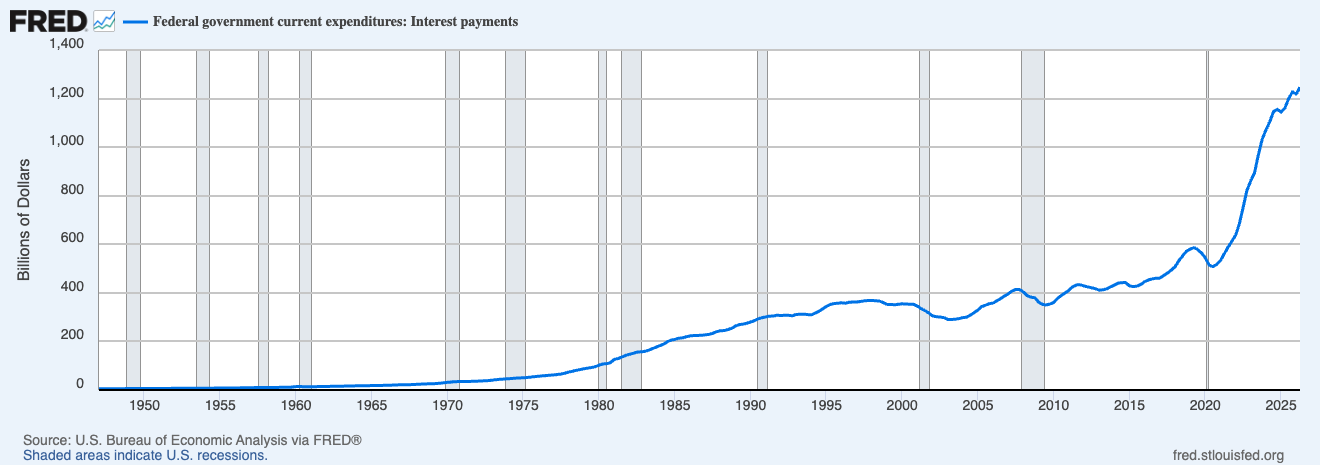
If cheap money was the other inflation accelerant (in addition to fiscal stimulus), what should the fastest hiking cycle in four decades have done? Take yourself back to 2022/2023: an inverted yield curve, a recession consensus close to unanimous, and every model saying the Fed was slamming on the brakes. However, the supposedly inevitable recession never arrived.
The interest income channel is why. In aggregate, the federal government is a large net payer of interest. By raising the policy rate, the government raised aggregate interest income. The government is now paying out over $1.2 trillion in interest per annum. This is a policy choice.
As a result, household interest income surged, cash-flow coverage got better rather than worse, and risk-bearing capacity went up with it.
Inflation lessened slowly, which is what you'd expect if the supposed "tightening" was feeding income into the same balance sheets it was supposed to squeeze, especially as supply chains normalized.
Conclusion
We want to be careful about what this framing doesn't do. It doesn't say the COVID-era policies were well-designed, evenly distributed, or constructed with inflation in mind. Supply was genuinely broken and prices illustrated that quickly. What we are arguing is the transmission mechanisms most people debate are majorly misunderstood.
This matters well beyond one opinion column. If you believe QE is stimulus and rate hikes are restraint, you spent 2022 and 2023 waiting for a recession that never arrived, and you will misread the next cycle the same way. If you believe the reverse, that removing duration income weakens balance sheets and paying interest strengthens them, then the last four years look like roughly what should have happened.
That is a testable difference, not a philosophical one. Watch what happens the next time the Fed cuts aggressively and restarts asset purchases. From the conventional point of view, that is stimulus and should be inflationary. From our perspective, it withdraws income from the private sector, and the effect likely runs the other way.
Whether the government should have spent that money is a political question. We are less concerned about this. What actually happened to balance sheets when it did is a mechanical one. For our purposes, that is the question worth getting right.
This matters for investors because the two perspectives produce opposite positioning at precisely the moments that cost the most. The 2022–23 hiking cycle is the cleanest example on record. The conventional read said tightening, the inverted curve said recession, and the consensus positioned for a downturn that never arrived. Conversely, our perspective said balance sheets were improving rather than being squeezed, and that risk assets would keep performing.
That was not a close call and it was not just luck. It followed directly from the data.